Self-updater
nParse+ checks the project's GitHub releases at startup (disable in Settings → General). Drafts and prereleases are ignored; versions are compared properly (1.10 > 1.9).
You can also check on demand: Check for updates in the tray menu, or Check now in Settings → General. Either reports back even when you're already on the latest version.
When an update exists:
- the tray menu gains an Install update vX.Y.Z entry, and
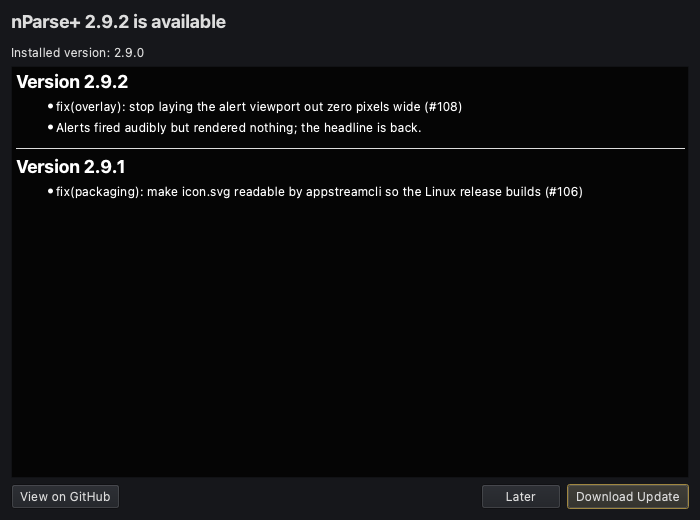
- clicking it shows a dialog with the release notes for every version between yours and the newest, then downloads the right asset for your platform:
| Platform | Asset picked |
|---|---|
| macOS | the .dmg matching your Mac's architecture (arm64 / x86_64) |
| Windows | .zip |
| Linux (tarball install) | .tar.gz |
| Linux (running inside the Flatpak sandbox) | .flatpak, handed to your software installer |
If the expected asset isn't on the release, the release page opens in your browser instead.
Releases also carry a -macos-<arch>.zip of the same .app beside each DMG.
It exists for the app's own use — a zip is what code can unpack without
mounting a disk image — and the DMG stays the download for a person.
Verified downloads
Every download is checked against the sha256 checksum GitHub publishes for that asset before anything opens it, and a download that doesn't match is deleted rather than handed to you. Three outcomes are reported differently, because they mean different things:
| What you see | What happened |
|---|---|
| Update download refused | The bytes that arrived are not the ones the release describes. Almost always a corrupted or interrupted transfer — try again. Nothing was installed, and the release page is not opened for you: it serves the same artifact that was just refused. |
| Update download failed | The transfer never completed (timeout, server error, dropped connection). A network problem; the release page opens so you can fetch it by hand. |
| Update downloaded, but not verified | The download completed, but that release publishes no checksum to check it against. Only releases from before GitHub served per-asset checksums are affected. |
The refusal dialog's Show Details carries both checksums — the one published and the one that arrived — which is the useful thing to paste into a bug report.
Note what this check is: the checksum travels over the same connection as the release information that describes it, so it proves the file you got is the file GitHub named. It is not a signature, and it does not defend against anything able to publish a release in the first place.
Settings always survive updates — see
Updating for the per-platform install
steps, and note that Flatpak installs are better served by plain
flatpak update.